
 Spanish
CONTACT US
info@bidaiondo.com










E-commerce in Spain registers its biggest growth since 2022 (+22.6%).
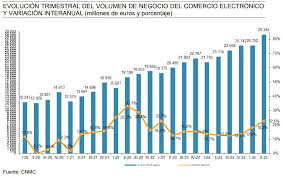
As you know, for years we've been analyzing the CNMC's quarterly publications on the state of e-commerce in Spain for you. They are the official source of reference for understanding the sector's performance and allow us to see how it's changing over time. Thanks to them, for example, we were able to witness firsthand the meteoric rise of online shopping habits in our country during the strictest phase of the lockdown and the pandemic. Now, the CNMC has just published the data for the second quarter of 2025, and… it's very good. E-commerce revenue in Spain increased by 22.6% year-on-year, reaching €28.346 billion. If a few months ago we predicted that e-commerce revenue in Spain was on track to exceed €100 billion by 2025, we can now consider it a reality. The second-quarter data far surpasses that psychological barrier of €25 billion per quarter, which had already been slightly exceeded in the two previous periods. From the first quarter of 2020 to the second quarter of 2025, business volume has grown from €12.243 billion to a record high of €28.346 billion. This increase means the sector has multiplied its size by 2.3 in just five years. After extraordinary growth in the second quarter of 2022, reaching a peak of 33.1% year-on-year growth, the market experienced a stabilization phase during 2023 and the first half of 2024, with more moderate growth rates between 12% and 15%. However, from the third quarter of 2024 onwards, a new upward trend is evident, culminating in the second quarter of 2025 with robust growth of 22.6%. However, these figures must be put into context. Regarding geographic segmentation, 45.8% of revenue originated in Spain, but the remaining 54.2% were purchases originating in Spain but made abroad. In other words, more than half of Spanish eCommerce revenue is generated when Spanish residents buy from platforms located outside the country. In fact, the net external balance (the difference between purchases from abroad to Spain and purchases from Spain abroad) showed a deficit of €11.345 billion. Specifically, 94.5% of purchases from abroad are directed to the European Union, which is directly related to the fact that some giants of the digital ecosystem have centralized their European operations in a few member states, such as Ireland and Luxembourg. In terms of the number of transactions, 36.2% of sales were destined for Spain, and 63.9% for other countries. The sectors with the highest volume of business from Spain to other countries were auxiliary services to financial intermediation (9.4%) and clothing (9.3%). Tourism, the tireless engine of Spanish online commerce Once again, and I doubt this trend will break in the near future, tourism is the driving force behind online sales in Spain. Thus, travel agencies and tour operators top the list of sectors that generate the most revenue, with 10.0% of the total business volume. If we add this percentage to that of air transport (7.4%) and hotels and similar accommodations (4.7%), we see that the tourism and travel industry accounts for almost a quarter of all e-commerce spending in Spain. Regarding the consumption of physical products, clothing ranks as the third most important sector with 6.2%, making it the best-selling pure retail category through digital channels. Other sectors in the Top 10 Auxiliary services to financial intermediation: 5.1%. Gambling and betting: 4.6%. Public administration and taxes: 3.9%. Artistic and sporting events: 3.8%. Hypermarkets and food stores: 3.2%. Restaurants: 3.0%. In any case, if we look at the number of online transactions, more than 493 million were recorded in the second quarter of 2025, 16.8% more than the previous year. However, tourism is largely excluded from this: gambling and betting led the ranking in terms of sales (9.3%): low-value but high-volume transactions that, unfortunately, continue to hold a privileged position in this ranking.
Last news
Qué métricas deberías mirar cada semana si vendes en Amazon

Amazon celebra 15 años en España y cuela un patrón oscuro en su fiesta

online trading systems.
 We show you the best way to market products and services online, through a professional service of installation, management and maintenance of your virtual store
We program to suit you
 We help you achieve operational excellence in all your business processes, whether they are production, logistics, service or office processes. In addition, we assure you to maintain continuous improvement in your management.
Bidaiondo Articles
You can now use ChatGPT's Ads Manager in Spain

ChatGPT's highly anticipated Ads Manager is now available in Spain in beta, as it is in the rest of the EU and selected markets in the Middle East, India, and North Africa. This means OpenAI has quickly addressed one of the main shortcomings of its advertising ecosystem in Spain, where it launched its GPT Ads platform on August 24th. Until now, Spanish advertisers were limited to managing their campaigns through OpenAI's Advertising Solut...
Lidl leads the ranking of most downloaded shopping apps. Temu and Shein fail to climb in the top 10.

In the previous chapter, we left you with a cliffhanger worthy of a top-tier series: the apps of the main Chinese marketplaces were experiencing a significant drop in downloads in Spain and the rest of the EU. We linked this to the implementation of the new €3 fee for low-value shipments and the impact it would have on their business. Now, we have even more data pointing in that direction, but it's time to see if Temu, Shein, or AliExpre...
ABOUT US
FILES







Welcome to Bidaiondo, dear user
BIDAIONDO SL, as the party responsible for the website www.bidaiondo.com, uses its own operating cookies and those of third parties of an analytical nature to allow the use of the website, analyze our services and show you information related to your preferences based on a profile drawn up from of your browsing habits (for example: pages visited). Please bear in mind that, if you do not activate some types of cookies, such as operational and analytical cookies, your experience of using this website may be affected. You can obtain more information and configure your preferences in the CONFIGURE option that appears below, you can reject cookies in the REJECT AND CLOSE option or accept all cookies and continue browsing in the ACCEPT AND CLOSE option.
So do you want to know more?
Data privacy seems important to you, and it is to us too. We store cookie data for 13 months. If you want to know more, you can visit our pages Privacy Policy y Cookies policy. Do you know what cookies are? Cookies are files that are used by virtually all websites. When browsing our page, they are installed in your browser or device to ensure that the website works correctly and store information about your visit. The data provided by cookies treat the user anonymously and in no case do they store personal information.
The data collected by the cookies we use are:
- Addresses IP
- References of visited pages
- References of downloaded files
- The website itself www.bidaiondo.com
- https://www.moz.com
- https://secure/europeanssl.eu